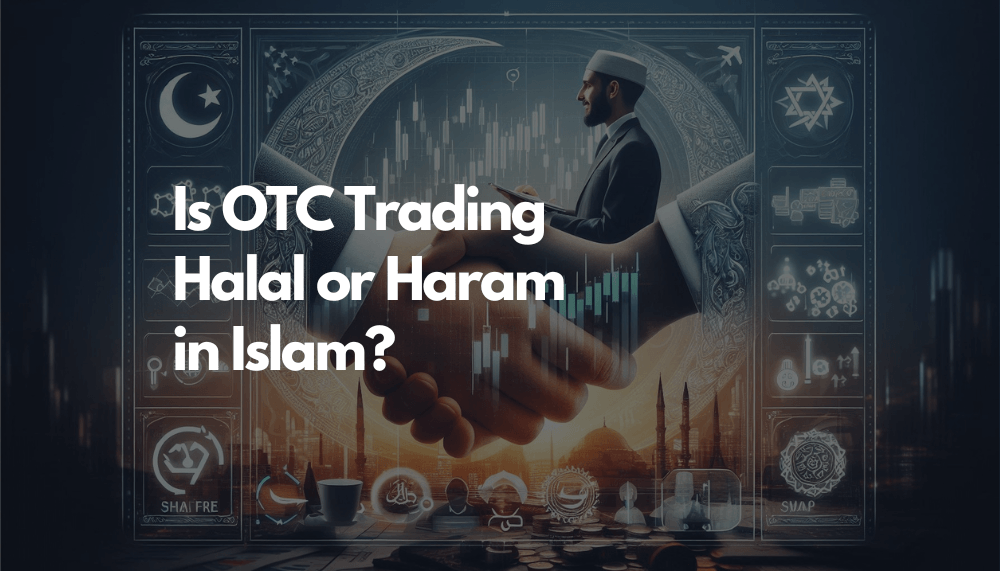
Many experts have differing opinions on whether OTC trading can be considered halal or haram, depending on how the contracts are structured. It can align with Islamic finance principles and be seen as halal, but only if it avoids elements like riba (interest), gharar (excessive uncertainty), and investments in haram sectors. For a trade to be permissible, it needs to be transparent, settled immediately, and free from speculation.
Over-the-Counter (OTC) trading is a vital part of today’s financial landscape, offering access to a range of instruments that you won’t find on traditional exchanges. However, for Muslim investors trying to make sense of these markets, a key question comes to the forefront: Is OTC trading halal according to Sharia? This question is especially significant for those seeking investments that are both financially sound and in line with their religious beliefs.
In this article, we delve into OTC trading in the context of Islamic investing and trading to shed light on how it can meet Sharia standards.
What is OTC Trading? How does it work?
Over-the-counter trading, often referred to as OTC trading, is all about buying and selling financial instruments through decentralised networks. If you’ve ever dabbled in cryptocurrencies like Bitcoin, you’re probably familiar with the concept of decentralisation. While the fundamental idea of decentralisation is at the heart of both OTC trading and the crypto world, the way it manifests in each arena has its own unique twists.
When you dive into over-the-counter trading, you’re typically making trades over the phone or, more frequently these days, through an electronic broker, essentially a trading platform. These brokers act as intermediaries, giving you access to platforms that offer a variety of tradable securities.
Brokers play a crucial role in facilitating exchanges between two parties. This typically involves a buyer and a seller who complete their transactions through a brokerage rather than directly on an exchange.
Since these transactions are processed via a broker or a group of brokers, the orders don’t go straight to an exchange. This setup is known as a decentralised system, as an exchange usually serves as a central control point. Consequently, orders managed outside an exchange and through a broker are classified as decentralised.
You can trade a variety of OTC securities online. While our main focus is on stocks, there are also other over-the-counter securities you can dive into:
1. Derivatives: Derivatives are unique securities that derive their value from an underlying asset. Essentially, you’re trading a contract or agreement linked to the asset rather than the asset itself. In the OTC market, you can engage in trading futures and forwards.
2. Bonds: Bonds are not bought and sold on official exchanges since they are issued by banks. Instead, they’re bought and sold through broker-dealer networks, which classifies them as OTC securities.
3. Foreign currency: The foreign currency exchange market operates on an over-the-counter (OTC) basis. This means that when you trade forex, you’re participating in a decentralised currency exchange.
4. Cryptocurrencies: As for cryptocurrencies, these exchanges also work as over-the-counter markets, primarily because there’s no central authority overseeing them. They allow for peer-to-peer transactions, making it easier for individuals to trade directly with one another.
Is OTC Trading Halal? Key Islamic Finance Criteria
Right now, many scholars are diving into a hot topic: Is the OTC market halal? This discussion is especially relevant as Islamic finance navigates some pretty complex trading scenarios. Here are the key points they’re focusing on:
- The issue of transparency: OTC transactions often happen behind closed doors, without the public price discovery we see in other markets. Some experts worry this could lead to unfair practices.
- Counterparty risk: If one party can easily back out or delay without clear terms, it shakes the foundation of trust (amanah) that’s so crucial in Shariah contracts.
- Gharar depending on the asset type: If an OTC trade involves unclear or ambiguous conditions, it can create a level of uncertainty that Islamic law doesn’t allow.
- Delayed settlements can be tricky: In spot trades, a T+2 settlement might work, but any situation where there’s a delay without clear guidelines can start to look a lot like a riba-based delay.
- The structure of a deal holds more weight than its label: Just because a deal is labelled as private or custom doesn’t mean it’s automatically haram. What really matters is whether it aligns with key Islamic principles, like avoiding interest, ensuring clarity, and preventing any unfair advantage.
- Some Sharia boards do allow certain over-the-counter (OTC) deals: If both parties are upfront about the terms, avoid interest, and the asset in question is halal, it could be accepted depending on the circumstances.
OTC products under the Islamic lens
1. OTC Forex and its compliance
When it comes to Islamic finance, Forex trading is a hot topic. Currency exchanges are permissible under certain conditions, such as spot transactions and immediate settlements. However, speculative Forex trading and margin trading are generally viewed as haram.
2. OTC derivatives and their Islamic ruling
Instruments like CFDs and options often stir up debate in Shariah due to their speculative nature and the fact that they involve delayed settlements. These elements typically clash with core Islamic principles. That said, not every financial instrument is treated the same.
Some well-structured contracts that minimise excessive uncertainty and avoid interest might be considered compliant, but this is something that needs to be assessed by qualified scholars. This evaluation is especially crucial when figuring out if the OTC market is halal, as the rulings can vary depending on how the transaction is structured and its intended purpose.
3. OTC crypto trading: permissible or not?
The debate around whether crypto trading is in line with Islamic law is still ongoing. Some scholars view cryptocurrencies as valid digital assets, especially when they’re used in straightforward and ethical transactions.
On the flip side, others are more hesitant, considering them to be highly speculative. To play it safe, it’s wise to stick to halal crypto assets that offer tangible benefits and steer clear of high-risk leverage.
When it comes to determining if over-the-counter crypto trading is halal, the nature, purpose, structure, and level of uncertainty of the transaction are all key factors to consider.
4. OTC fixed-time and binary options
Generally, binary options or fixed-time trading options are seen as impermissible in Islamic finance. Their similarity to gambling means they often fall outside the bounds of Shariah compliance. Most scholars advise against using these instruments, as their structure tends to lack transparency and can expose traders to unnecessary risks.
How to Trade OTC in a Halal Way?
Trading over-the-counter (OTC) can definitely be halal, but it’s important to set it up correctly and follow Islamic ethical guidelines. Here are some essential points to keep in mind:
1. Steer clear of derivatives and speculative contracts. These are often found in OTC transactions and can involve riba or gharar, which could compromise the halal status of the OTC market.
2. Make sure there’s complete transparency in asset pricing. Unlike exchanges, OTC markets don’t have the same price discovery, so Sharia-compliant trades need to clearly outline how the value is determined.
3. Stick to asset-backed trades. Every OTC transaction should be tied to a real, tangible asset instead of just paper or leverage.
4. Use wa’ad (unilateral promise) when necessary. Scholars allow this structure in OTC to minimise speculation while ensuring the deal aligns with Islamic principles.
5. Ensure there’s no delayed delivery for both parties. The asset and payment should be exchanged right away or according to pre-agreed halal structures like murabaha.
6. Get a third-party ethical screening. A Shariah board or advisor should review the OTC contract structure before trading to confirm compliance.
Scholarly Disclaimer on OTC Trading in Islam
Islamic rulings can vary among scholars and Shariah board on Over-the-Counter (OTC) trading. Thus, it is suggested that Investors consult qualified Islamic finance advisors before proceeding with any OTC transactions.
Conclusion
OTC trading isn’t automatically considered haram; whether it aligns with Sharia law really depends on how it’s structured and executed. In the realm of Islamic finance, ethical boundaries are clearly outlined; things like riba, excessive risk, and gambling are off-limits. So, Muslim investors need to dig a little deeper than just the surface and carefully assess the nature of each OTC transaction they engage in.
When done right, OTC trading can offer unique benefits such as flexibility, access to customised instruments, and greater privacy. However, these advantages should never come at the expense of Islamic ethical principles. It’s crucial to ensure that transactions are backed by real assets, that there’s mutual understanding and clarity, and that contracts are free from speculative risks and interest-related terms.